


The psoas, the “muscle of the soul”.
Yogis and somatic therapists have long referred to the psoas as the “muscle of the soul.” While this might sound poetic, it speaks to the deep, emotional resonance of this muscle. The psoas doesn’t just react to stress — it stores it. It holds the body’s silent stories of fear, freeze, and flight.
If the psoas is on constant alert, you may find yourself stuck in a chronic “protective” state, unable to access curiosity, openness, or connection.
 The diaphragm (your main breathing muscle) and the psoas are connected by fascia and share attachments along the spine.
When the psoas is tight, it can restrict the diaphragm’s movement, leading to shallow breathing, pain and tension all along the spine and back muscles. Long term psoas muscle tension can also create muscle tension all the way up through the spinal muscles into the neck
This diaphragm – psoas relationship is key to understanding why trauma survivors often describe a feeling of breathlessness.
It’s not just anxiety, it’s a physical compression that limits how deeply they can breathe. Without full breath, the vagus nerve (which calms the body) can’t do its job as effectively.
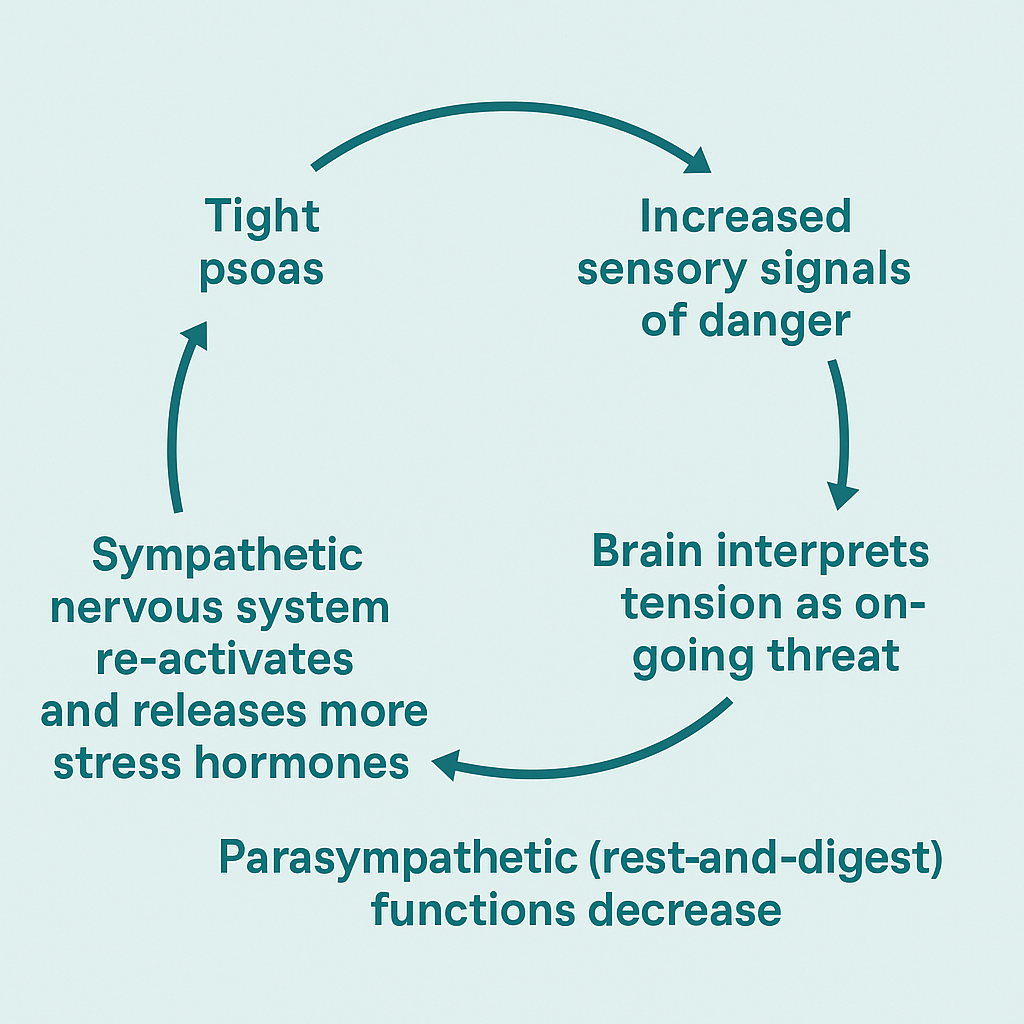
The vagus nerve, is like the Amazon River for bioligical information. It flows from brain to the tailbone, and supplies vital information to major organs along the way ( heart, lungs, gut ). When there’s stress or trauma this nerve becomes limited in its job of regulating the body, and the fight / flight response takes over.
This is turn send stress signals along its length, and into the psoas, where it responds with tightening ( preparing to run or fight).
Its an absolute need to return the body back to ‘rest, digest, calm’ state and release the experienced trauma or stress. This lets the psoas and diaphragm know its safe to be calm, its safe to rest, and in turn produces the body’s necessary chemistry to allow not only muscles relaxing fully, but also deep cellular repair that we all need for long and healthy lives.
